Hardware Electroplating Equipment works based on electrolytic action, using an electrochemical process to deposit metal or alloy coatings on the surface of hardware products to enhance their corrosion resistance, wear resistance, conductivity, and aesthetics. Below is a detailed explanation of its core principles and key aspects:
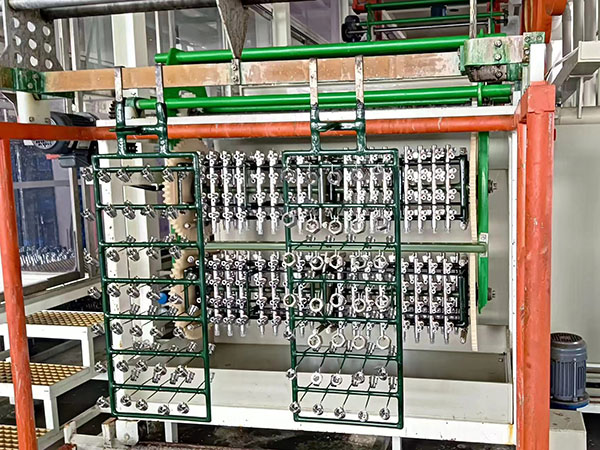
1. **Core Principles: Electrolytic Action and Redox Reactions**
**Electrolytic Cell Configuration**
**Cathode (Workpiece to be Plated)**: Hardware products (such as copper, zinc, nickel substrates) serve as the cathode, connected to the negative terminal of a DC power supply.
**Anode (Plating Metal)**: A metal plate corresponding to the plating layer (such as zinc, nickel, or gold) serves as the anode, connected to the positive terminal of a DC power supply.
**Electrolyte (Plating Solution)**: A solution containing metal ions for plating (e.g., zinc sulfate, nickel chloride), along with conductive salts, buffers, and additives to maintain ion concentration and plating layer uniformity.
**Electrochemical Reaction Process**
**Anode Reaction**: Metal atoms lose electrons and are oxidized to cations that enter the plating solution.
Example (Nickel Plating): Ni - 2e⁻ → Ni²⁺
**Cathode Reaction**: Metal ions in the plating solution gain electrons, reducing to metal atoms that deposit onto the workpiece surface.
Example (Nickel Plating): Ni²⁺ + 2e⁻ → Ni
**Side Reaction**: Hydrogen ions may reduce to hydrogen gas at the cathode, which needs to be suppressed by controlling current density and temperature.
2. **Key Technical Aspects**
**Plating Material Selection**
Choose plating metals based on functional requirements:
**Protective Coatings**: Zinc (anti-rust), Chromium (wear-resistant).
**Decorative Coatings**: Nickel, Copper (enhance gloss).
**Functional Coatings**: Silver (conductivity), Gold (corrosion resistance), Tin-lead alloys (lubrication).
**Alloy Electroplating**: Co-deposition of two or more metal ions (e.g., tin-lead alloys) to enhance overall performance.
**Process Parameter Control**
**Current Density**: Affects the deposition rate and uniformity of the plating layer. Excessively high current may result in rough and porous coatings.
**Temperature**: Maintain within an appropriate range (e.g., chromium plating requires 50-60°C). Low temperatures affect adhesion strength.
**pH Value**: Adjusted by buffers to avoid electrolyte decomposition or degradation of coating quality.
**Electroplating Time**: Determines the coating thickness and needs to be accurately calculated according to Faraday's law of electrolysis.
**Auxiliary Equipment and Functions**
**Stirring Device**: Uses mechanical stirring, air agitation, or ultrasonic stirring to enhance the uniformity of the plating solution.
**Filtration System**: Circulates and filters the plating solution to remove impurity particles and prevent coating defects.
**Temperature Control System**: Heats or cools the plating solution to maintain the required process temperature.
**Drive System**: Drives the movement, lifting, or rotation of the workpieces, ensuring uniform coverage of the plating layer.
3. **Technical Optimization Directions**
**Environmental Sustainability**
Adopt cyanide-free electroplating processes (e.g., cyanide-free gold plating, cyanide-free silver plating) to reduce the use of toxic substances.
Promote the substitution of trivalent chromium for hexavalent chromium, reducing toxicity and meeting environmental standards.
Achieve wastewater closed-loop treatment, recycling heavy metals and water resources.
**High Performance**
Develop nano-composite coatings to provide self-healing, superhydrophobic, and other characteristics.
Create functional intelligent coatings (e.g., thermochromic, photocatalytic coatings) to expand application scenarios.
Optimize electroplating for lightweight materials (e.g., magnesium alloys, carbon fiber surface metallization).
**Intelligent Automation**
Introduce PLC control systems and computer technologies to automate current setting, automatic chemical additive injection, and fault diagnosis.
Deploy AI-based vision inspection systems to identify coating defects such as pinholes or burrs in real-time, improving product yield.
Use big data analytics to optimize process parameters and enhance production efficiency and stability.