The **ramp-type cantilever production line** is an industrial equipment that combines ramp conveyor technology with cantilever lifting functions. It is mainly used for automated material handling in high-angle or vertical scenarios. The core function is achieved through a wave-edge conveyor belt or an intelligent cantilever for efficient and stable transportation. It is widely applied in manufacturing, logistics, and other industries. The main features of the **ramp-type cantilever production line** can be summarized as follows:
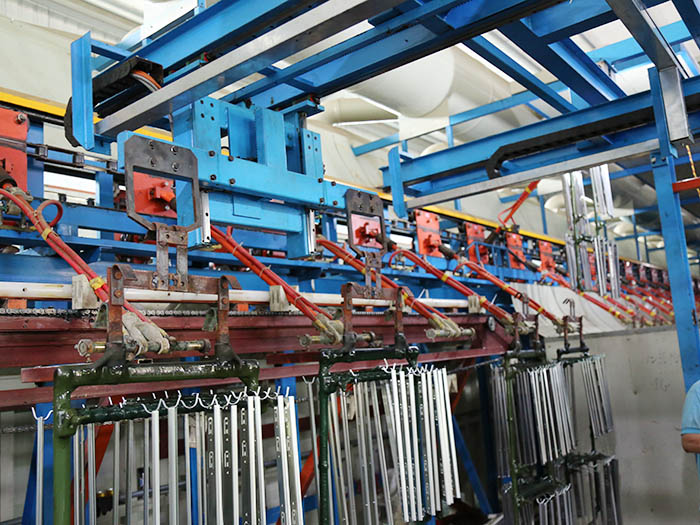
**Double-row chain structure, high strength and stability**
The double-row parallel alloy steel chain design is adopted, driven synchronously by sprockets to form a "steel backbone" structure. This design provides extremely high strength and stability, able to bear loads much greater than those of single-row chains, meeting the demands for transporting large quantities and heavy materials. For example, in electroplating processes, it can carry up to 20kg per hook and run continuously for 24 hours.
**Excellent climbing ability, optimized space layout**
Specially designed for connecting production floors or process segments at different heights, it achieves continuous, stable material transport from low to high. The ramp angle is generally no more than 30 degrees (if larger angles are required, anti-slip rollers or baffles can be added), breaking the limitations of traditional flat production and enabling the use of vertical space. For example, in a food processing plant, it can lift cleaned fruits and vegetables from the first floor to the second floor packaging line, reducing the need for ground-level transportation paths.
**Modular design, convenient maintenance**
The chain is designed with a modular structure, allowing individual sections to be replaced directly without dismantling the entire conveyor line, significantly reducing maintenance costs and time. For example, in flour processing scenarios, the stainless steel chain is resistant to dust and can be cleaned daily with a high-pressure water gun. It also does not deform in low-temperature environments, requiring only regular lubrication for maintenance.
**Anti-slip and anti-jamming design, suitable for various materials**
For wet or easily-sliding materials, baffles (e.g., 5cm high baffles) can be added between the chains to prevent sliding and ensure continuous transport for up to 2 hours without material jamming. Additionally, by adjusting the mesh belt gap (ranging from 0.5mm to 5mm), conveyor speed (adjustable from 0.25m/s to 1.6m/s), and ramp angle, the system can accommodate the transport of various materials such as bulk fruits and vegetables, granular grains, and packaged finished products.
**Intelligent control to enhance production efficiency**
Modern ramp-type cantilever production lines integrate intelligent sensing and control technologies. Vibration sensors, temperature sensors, and torque sensors are deployed on the sprockets, motors, and guide rails to collect real-time operating data and upload it to the cloud. This enables fault prediction (e.g., predicting sprocket wear 30 days in advance) and reduces unplanned downtime by 80%. Additionally, AI technology can dynamically adjust the transport path, optimizing production cycles based on order priorities, equipment status, and material inventory.
**Efficient and durable, reducing long-term operating costs**
Core components are made from alloy steel and undergo heat treatment, with an average mean time between failures (MTBF) of over 8,500 hours, offering a lifespan three times that of conventional belt conveyors. Each unit can transport 1-50 tons of material per hour, far exceeding manual efficiency, with daily maintenance costs only one-third of those of belt conveyors.