Cantilever-type Nickel Plating Production Line core components include four major modules: mechanical structure, electroplating system, control system, and auxiliary equipment. These modules work in synergy to achieve efficient and stable electroplating of workpieces. Below is a detailed analysis:
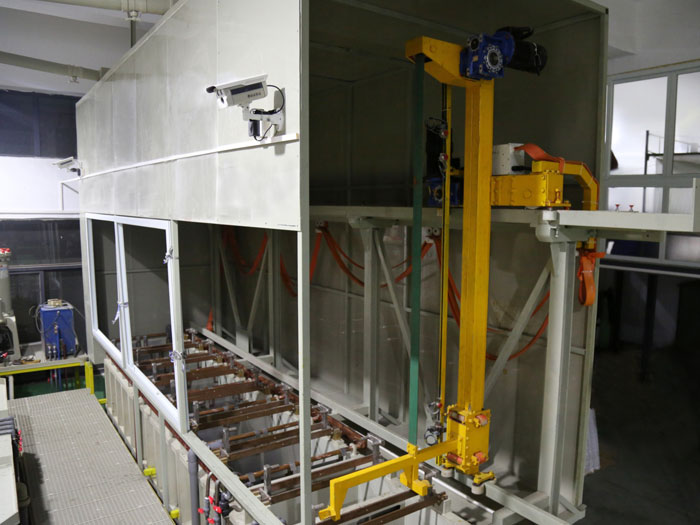
1. **Mechanical Structure: Core Framework for Loading and Movement**
**Cantilever System**
**Drive Mechanism**: Composed of a motor, reducer, and chain (or gear), this system achieves vertical lifting (adjustable speed: 6~24m/min) and horizontal movement (adjustable speed: 6~30m/min). For example, the cantilever length typically ranges from 1.2 to 4 meters, with load capacity covering 10kg to 50kg, suitable for medium and small parts (e.g., electronic components, printed circuit boards).
**Cantilever Structure**: Made of high-strength steel welded together, it supports the weight of the plated items and ensures smooth operation. Some designs are equipped with balance wheels or counterweights to reduce the motor load and extend service life.
**Movement Track**: A linear track is fixed to the workshop floor or bracket, guiding the cantilever's horizontal movement. Track materials are typically stainless steel or aluminum alloy, with a finely processed surface to reduce friction resistance.
**Tank Layout**
**Pre-treatment Tank**: Includes degreasing tank (to remove grease), acid washing tank (to remove oxide layers), and activation tank (to increase surface activity), providing a clean base for electroplating.
**Nickel Plating Tank**: The core reaction vessel containing nickel plating solution (including nickel salts, complexing agents, additives, etc.), where nickel is deposited on the workpiece surface through electrode reactions. Tank materials are usually polypropylene (PP) or polyvinyl chloride (PVC), offering strong corrosion resistance.
**Post-treatment Tank**: Includes washing tank (to remove residual plating solution), passivation tank (to improve corrosion resistance), and drying tank (to accelerate moisture evaporation), ensuring stable plating quality.
**Layout Principle**: Tanks are arranged in a straight line according to the process flow, shortening the transfer path for workpieces and reducing exposure time (time workpieces are exposed to air) to prevent oxidation or contamination of the coating.
**Frame and Foundation**
**Main Frame**: Welded from section steel, the frame fixes the crane track and supports the cantilever and workpiece weight. The frame can be segmented for modular assembly to adapt to different workshop heights and layouts.
**Foundation Reinforcement**: Concrete foundations are poured at the installation site to ensure smooth operation of the equipment and prevent vibration from affecting the coating quality.
2. **Electroplating System: Core Reaction Unit for Layer Deposition**
**Power Supply System**
**Rectifier**: Converts alternating current (AC) to direct current (DC) to provide stable current for electroplating. The output voltage typically ranges from 0 to 18V, with adjustable current density (2~10A/dm²), supporting constant voltage or constant current modes.
**Filtering Device**: Reduces power ripple, ensuring current stability and preventing defects like streaks or pinholes in the coating.
**Electrode Components**
**Anode**: Made from soluble nickel plates (e.g., Watt’s nickel anode) or insoluble anodes (e.g., titanium-based coated anode), chosen based on plating solution composition and process requirements. Anodes require regular cleaning or replacement to maintain reaction efficiency.
**Cathode**: The workpieces are connected to the negative pole of the power supply using conductive clamps, ensuring uniform current distribution. Clamp designs should avoid blocking the surface of the workpieces, affecting coating uniformity.
**Plating Solution Circulation System**
**Pumps and Pipes**: The circulation pump draws plating solution from the tank bottom to the top spray nozzles, creating convection to enhance solution uniformity. Pipes are made from corrosion-resistant materials (e.g., PVDF or PP).
**Filtering Device**: Equipped with bag or plate-type filters, it removes solid particles and impurities from the plating solution, preventing defects like pinholes or rough surfaces.
**Temperature Control System**: Heaters or cooling coils are used to adjust the plating solution temperature (typically 45~60°C), ensuring stable reaction rates. A temperature control accuracy of ±1°C is ideal.
3. **Control System: Core Brain for Automated Operation**
**PLC Control Unit**
**Program Settings**: Supports storing multiple process programs (e.g., different plating thicknesses, current and time parameters for various coating requirements), enabling quick recall via touch screen or buttons.
**Motion Control**: Precisely controls cantilever lifting, horizontal movement, delayed stop, etc., ensuring workpieces are transferred along preset paths. For example, the dwell time of workpieces in the nickel plating tank can be controlled to the second level.
**Safety Interlocks**: If abnormalities (e.g., low plating solution level, temperature overrun) are detected, the system automatically stops equipment and triggers an alarm to prevent accidents.
**Sensors and Feedback System**
**Liquid Level Sensor**: Monitors the plating solution level and automatically triggers replenishment or shutdown protection to prevent dry burn or overflow.
**Temperature Sensor**: Provides real-time feedback of plating solution temperature, working in conjunction with the temperature control system for closed-loop control.
**Current Sensor**: Monitors the actual current value, adjusting power supply output to maintain consistent coating quality.
**Human-Machine Interface**
**Touch Screen**: Displays equipment operation status, process parameters, fault information, etc., supporting parameter modifications and historical data queries.
**Operation Buttons**: Includes emergency stop, start, pause, and other physical buttons for quick response in emergencies.
4. **Auxiliary Equipment: Supporting Systems Ensuring Stable Production**
**Ventilation System**
**Exhaust Hood**: Installed above the nickel plating tank, the exhaust hood creates negative pressure to suck out acidic gases (e.g., hydrogen, sulfuric acid mist) produced during electroplating, protecting operators' health.
**Purification Device**: Equipped with acid mist purifiers or activated carbon adsorption devices to treat exhaust gases before discharging them into the atmosphere.
**Cleaning System**
**Spraying Device**: Spray pipes are installed in the pre-treatment and post-treatment tanks to wash the workpiece surface using high-pressure water, improving cleaning efficiency.
**Pure Water System**: Provides deionized water for final cleaning to prevent contamination of the coating from impurities in tap water.
**Waste Liquid Treatment System**
**Neutralization Tank**: Treats waste plating solution by neutralizing acids and alkalis, adjusting the pH value to neutral before discharge.
**Sedimentation Tank**: Adds flocculants to precipitate heavy metal ions, separating clean water from sludge and reducing environmental pollution risks.