The double-barrel barrel plating production line is an automated electroplating equipment equipped with two independent drums. It realizes efficient batch plating treatment of small parts (such as screws, electronic components) through the collaborative operation of double drums, and is suitable for hardware, electronics and other industries. Next, let us take you to learn about the operating procedures of the
double-barrel barrel plating production line as follows:
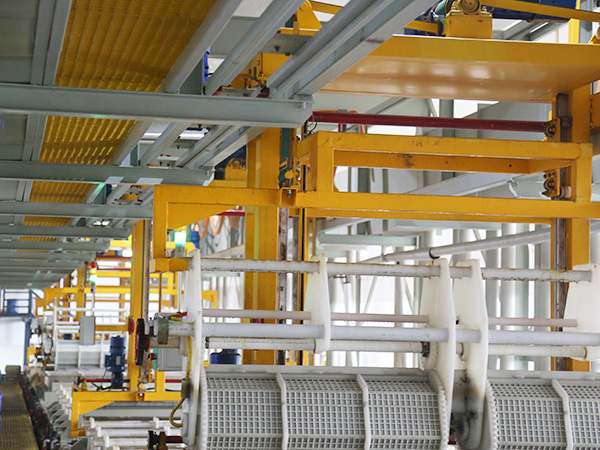
Equipment Inspection and Preparation
Confirm that all components of the double-barrel barrel plating production line (such as drums, transmission devices, power supply systems, solution circulation systems) are intact, without looseness or leakage.
Check whether the small holes on the drum wall panels are unobstructed to ensure the normal circulation of electrolyte; verify the elasticity of the cathode conductive device to avoid part jamming.
Clean the drums and plating tanks to remove residual impurities and prevent contamination of new batches of solution.
Solution Preparation and Addition
According to the electroplating materials (such as zinc, copper, nickel, etc.) and process requirements, accurately prepare the electrolyte, including main salts, conductive salts, buffers and additives.
Inject the prepared solution into the plating tanks of the double-barrel barrel plating production line to ensure the liquid level meets the process standards.
Part Loading and Fixation
Load the small parts to be plated into the drums, with the loading capacity controlled at 25%-30% of the drum volume to avoid poor tumbling due to excessive loading or reduced efficiency due to insufficient loading.
Close and lock the drum doors to ensure reliable closure and tight door gaps, preventing leakage of parts or solution during electroplating.
Parameter Setting and Startup
Set the drum rotation speed according to the part material and plating requirements: ≤15 revolutions per minute for soft coatings, ≥15 revolutions per minute for hard coatings.
Adjust the current density and electrolyte temperature; excessively high current density is prone to cause rough coatings, and the temperature must be stabilized within the range required by the process.
Start the double-barrel barrel plating production line; the drums rotate in the set direction, and the parts continuously tumble and fall inside the drums to achieve uniform plating.
Electroplating Process Monitoring
Real-time observation of electrolyte level, temperature and current changes to ensure they fluctuate within the set range.
Regularly inspect the coating quality; if rough, blackened or burnt coatings are found, adjust the current density or temperature immediately.
Monitor the solution composition, timely supplement the consumed main salts, brighteners, etc. according to the analysis results, and remove accumulated impurities.
Completion of Electroplating and Part Removal
Stop the operation of the double-barrel barrel plating production line after reaching the predetermined electroplating time or coating thickness.
Open the drum doors and take out the electroplated parts; avoid direct contact with hands to prevent coating damage.
Transfer the parts to the cleaning tank and rinse with clean water to remove residual electrolyte on the surface and prevent corrosion.
Post-Treatment and Equipment Maintenance
According to process requirements, perform post-treatments such as polishing and passivation on the parts to improve coating hardness, smoothness and corrosion resistance.
Clean the drums and plating tanks to remove residual impurities; check whether the small holes on the drum wall panels are blocked and clean them in a timely manner.
Conduct comprehensive regular maintenance on the double-barrel barrel plating production line, including lubrication of transmission devices, inspection of power supply systems and cleaning of solution circulation systems.