The U-shaped galvanizing barrel plating production line is an automated barrel plating equipment adopting a U-shaped layout, specially designed for galvanizing treatment of small parts. It features high efficiency and space-saving, and is suitable for mass production in industries such as hardware, electronics, and auto parts. Therefore, the
U-shaped galvanizing barrel plating production line can improve production efficiency through the following measures:
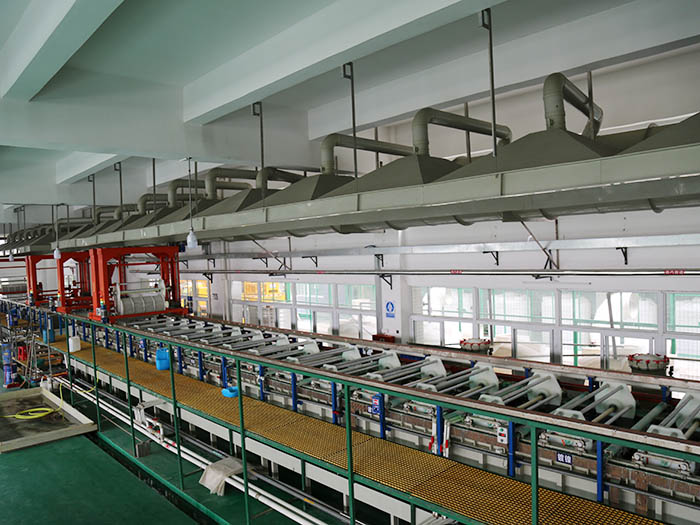
Optimizing Drum Design
Size and Shape: Adopting slender drums instead of short and thick ones, the surface area of parts in the same volume is larger, which can shorten the effective plating time. For example, the surface area of parts in a hexagonal drum (450×Φ180mm) is increased by about 20% compared with that of (300×Φ220mm), significantly improving barrel plating efficiency.
Open Area Ratio: Increasing the drum open area ratio (e.g., from 25% to 35%) can enhance water permeability, reduce the resistance of main metal ion supplementation, and improve cathode current efficiency, thereby accelerating the coating deposition rate.
Material and Process: Selecting temperature-resistant, wear-resistant, acid and alkali-resistant materials, and adopting computer typesetting for automatic punching to ensure uniform aperture without burrs and reduce part damage.
Controlling Drum Loading Capacity
Optimal Ratio: The loading capacity is preferably 1/3 to 2/5 of the drum volume. Excessive loading will lead to prolonged mixing cycle and rapid decrease of metal ion concentration; insufficient loading may cause failure of normal contact between parts and cathode conductive head due to too few parts. For example, when the loading capacity of ordinary parts is controlled at 1/3, the production efficiency and plating solution stability are optimal.
Dynamic Adjustment: Adjust the loading capacity according to the electroplating time of products. If the electroplating time of a product is shorter than the longest station time, the loading capacity can be increased to 1/2 to avoid station idleness and improve production capacity.
Shortening Traveler Cycle Time
Automated Control: Adopting PLC (Programmable Logic Controller) to monitor traveler operation in real time, combined with DMS intelligent system to realize automated management of production data, reduce manual intervention, and ensure the shortest traveler cycle time.
Equipment Upgrading: Using imported brake motors and nylon reinforced belts or chains to lift the traveler, with a lifting capacity ranging from 50kg to 990kg, meeting production needs of different scales while reducing failure rates.
Optimizing Process Flow
Flexible Process Combination: The U-shaped layout supports processing parts with the same electroplating process but different thickness combinations on the same production line, or realizing different process combinations (such as galvanizing, copper plating, nickel plating, chromium plating, and aluminum oxidation, etc.), reducing equipment switching time.
Precise Parameter Control: Through PLC full-program control or manual-automatic switching operation, accurately set the residence, dripping, and delay time of each station to avoid rework or low efficiency caused by parameter deviations.
Introducing Intelligent Technology
Real-time Monitoring and Feedback: Using Internet of Things (IoT) technology to collect production data (such as temperature, current, traveler position, etc.) in real time, discover abnormalities and make adjustments in a timely manner through data analysis, reducing downtime.
Predictive Maintenance: Monitoring equipment status (such as motor temperature, drum wear, etc.) through sensors, early warning potential failures, avoiding unplanned downtime, and ensuring production continuity.
Improving Employee Skills and Collaboration
Multi-skill Training: The U-shaped layout requires employees to have multi-process operation capabilities (such as cutting, sewing, ironing, analogous to feeding, electroplating, post-treatment in barrel plating). Training is conducted to improve employees' skill breadth and reduce process switching time.
Team Collaboration Optimization: The U-shaped layout shortens the distance between employees, facilitating information exchange and quick problem-solving. For example, when a problem occurs at a certain station, nearby employees can provide immediate assistance to avoid long-term downtime.
Space and Logistics Optimization
Compact Layout: The U-shaped design enables tight arrangement of equipment, reducing blank areas in the factory building and improving space utilization. For example, under the same area, the U-shaped layout can accommodate more stations than the traditional linear layout, shortening material handling distance.
Reducing Handling Time: Materials flow along the U-shaped path without long-distance handling, reducing transportation costs and time consumption. For example, after an electronics factory adopted the U-shaped layout, material handling time was reduced by 30% and production efficiency was increased by 15%.