Can you explain the technical features of using a chemical nickel plating production line?
The **chemical nickel plating production line** is a non-electroplating technology system that deposits a nickel-based alloy layer on the substrate surface through a self-catalytic reduction reaction, without the need for an external power supply. It is suitable for surface enhancement treatment of workpieces with complex shapes. Below are the technical features of using a **
chemical nickel plating production line**:
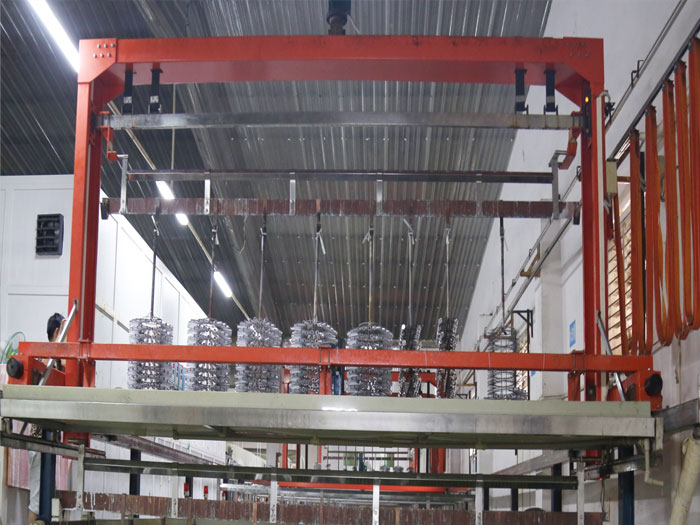
**Uniform Coating**: Without the influence of an electric field, substrates with complex shapes (such as deep holes, grooves, and inner walls of pipes) can achieve a uniformly thick coating (thickness deviation ≤5%), which is superior to electroplated nickel.
**High Corrosion Resistance**: The nickel-phosphorus alloy coating is dense and amorphous (high-phosphorus coating) or microcrystalline, effectively isolating the substrate from corrosive media. In particular, the corrosion resistance is superior to pure nickel coatings in acidic environments.
**Hardness and Wear Resistance**: The coating hardness is 300-500 HV (medium phosphorus), and after heat treatment, it can reach 800-1100 HV (close to hard chrome), with better wear resistance than electroplated nickel.
**Good Adhesion**: Strong adhesion to metals (steel, aluminum, copper, etc.), ceramics, plastics (after activation treatment), and other substrates (typically >50 MPa), with no peeling phenomenon.
**Wide Substrate Applicability**: Suitable not only for metal substrates but also for non-metallic substrates (such as plastics, ceramics, etc.), requiring only appropriate pretreatment.
**No Power Supply Needed**: Energy-saving, environmentally friendly, and does not require water treatment systems.