Waste Gas Treatment Environmental Protection Equipment mainly refers to a type of environmental protection equipment that adopts different process technologies to recover, remove or reduce harmful components in exhaust emissions, so as to protect the environment and purify the air. It plays a vital role in protecting ambient air quality, reducing air pollution, maintaining ecological balance and safeguarding human health. The detailed introduction is as follows:
Activated Carbon Adsorption Equipment: It utilizes the abundant microporous structure and huge specific surface area of activated carbon to generate a strong adsorption force field. When the waste gas passes through the activated carbon layer, harmful substances such as organic pollutants and odor molecules in the waste gas are adsorbed on the surface of activated carbon, thus realizing waste gas purification. This equipment has a remarkable treatment effect on low-concentration and large-airflow organic waste gas, with advantages of low investment cost and simple operation. However, the activated carbon needs to be replaced regularly after adsorption saturation, otherwise the treatment effect will be affected.
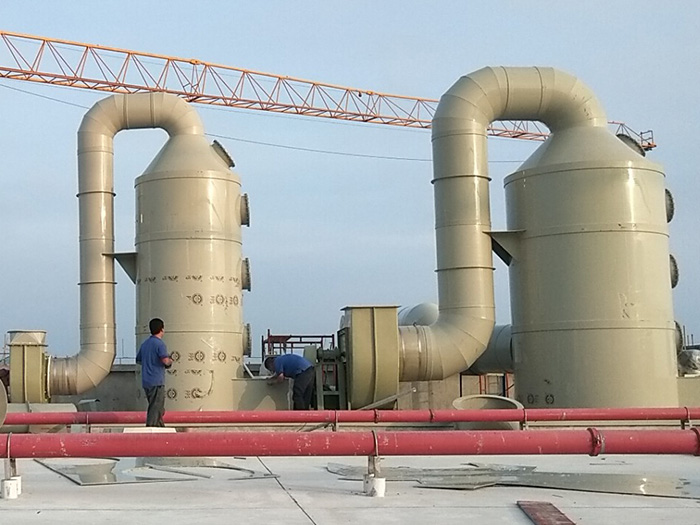
Spray Washing Equipment: Also known as water scrubber, it is a gas-liquid contact device. The waste gas is fully contacted with liquid, and the concentration of waste gas is reduced by utilizing the solubility of waste gas in water or chemical reactions with chemical dosing. This equipment is suitable for treating water-soluble malodorous gases from organized emission sources, with advantages of simple process, convenient management and low equipment operation cost, but its purification efficiency is low and it should be used in combination with other technologies.
Low-Temperature Plasma Purification Equipment: Under the action of an external electric field, a large number of energetic electrons generated by dielectric discharge bombard pollutant molecules, causing them to ionize, dissociate and excite, and then trigger a series of complex physical and chemical reactions, converting complex macromolecular pollutants into simple small-molecule substances, or transforming toxic and harmful substances into harmless or low-toxic and low-harm substances, so as to achieve the purpose of degrading pollutants. This equipment has significant advantages in the treatment of gaseous pollutants, including no need for high-cost chemical reagents, stable operation, corrosion resistance and strong load impact resistance.
Photocatalytic Oxidation Equipment: It uses semiconductors and air as catalysts and light as energy to degrade organic matter into CO2 and H2O. The semiconductor adopted by this equipment is TiO2 photocatalyst with the highest reaction efficiency at present. After special treatment, it can reduce various waste and odorous gases such as aldehydes, benzenes, ammonia, nitrogen oxides, sulfides and other VOC organic and inorganic substances into carbon dioxide, water and other harmless substances under the action of photocatalytic oxidation, and also has deodorization effect. Since no additives are used in the photocatalytic oxidation reaction process, no secondary pollution will be generated.
Regenerative Thermal Oxidation (RTO) Purification Equipment: It oxidizes organic waste gas (VOCs) into CO2+H2O at high temperature (≥760℃) to purify the waste gas, and recovers the heat released during decomposition to achieve the dual goals of environmental protection and energy conservation. The overall purification efficiency of this equipment can reach more than 95%, with stable continuous operation. It also has advantages such as mature and reliable technology, simple use and maintenance, and long service life, but the one-time investment cost is high and the operation cost is relatively higher than that of traditional processes.