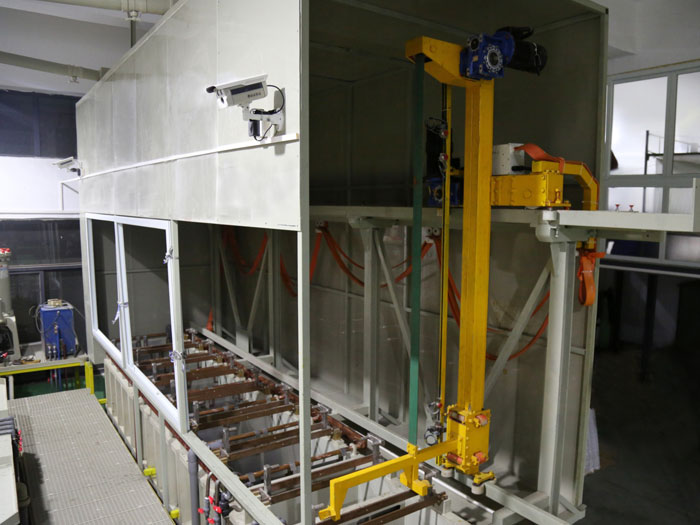
Gantry-type Galvanizing Production Line achieves high operational efficiency through multi-arm collaborative operation and automated control. This is reflected in four aspects: capacity, roller change efficiency, labor cost, and production continuity. The following is a detailed analysis:
1. Capacity Efficiency
Multi-arm parallel processing: The gantry-type galvanizing production line is typically equipped with 3 arms, each independently grabbing a basket containing workpieces and rotating at a fixed angle (e.g., 60 degrees). This allows the baskets to pass through various stations, including material loading, dipping, removal, and unloading. When one arm completes a cycle, the other two arms continue to process workpieces in sync, forming a continuous production flow.
Daily production range: Taking small workpieces as an example, a basket can carry up to 50 kg, and the galvanizing time is between 1 to 2 minutes (depending on material and thickness). With adequate pre-treatment supply, the daily output can reach 36 to 72 tons, meeting large-scale production demands.
2. Roller Change Efficiency
Before improvement, roller change time: Traditional production lines require line stoppage for roller changes. Starting the line with a new roller takes 5 hours, and stopping the line for a roller change takes 4 hours, severely affecting production continuity.
After improvement, roller change efficiency: By optimizing the roller change device, online roller changes are achieved, reducing the time for a single roller change to 45 minutes, significantly decreasing downtime and improving overall production efficiency.
3. Labor Cost
Before improvement, labor requirements: Changing rollers required 7 personnel (responsible for coordination, adjustment, balancing, monitoring, etc.) and 1 crane operator, who needed to be involved throughout the entire process.
After improvement, labor optimization: After improving the roller change device, the weight of each roller was reduced to 575 kg, and friction between the guide pulley and the roller track was minimized. Only 2 personnel are now required for the roller change, and the crane operator is only needed to lift the roller onto the roller mover, eliminating the need for full participation throughout the process, further reducing labor costs.
4. Production Continuity
Before improvement, production impact: On average, the production line experiences a stoppage or reduced speed once a month due to roller changes, resulting in approximately 60 tons of waste products per year. The shortest recovery time for production is 8 hours, and during normal operation, 180 tons of qualified products can be produced in 8 hours. The annual downtime results in a loss of 1,080 tons of qualified product plates, causing significant economic loss.
After improvement, production assurance: After the implementation of online roller change technology, the roller change process does not affect production, avoiding waste generation and capacity loss due to stoppages, and ensuring production continuity and stability.